header image
Suspension Drops – Tsuri Otosu, 吊り落とす
August 1st, 2011 under From the Editor's Desk. [ Comments: 1 ]


Several interviews with Akechi Denki (明智伝鬼) can be found on TokyoBound. In one of these, from 1997, the grandmaster speaks about the topic at hand:

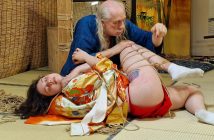
“During the Phantom Shows, I did a number of ‘tsuri-otosu’ (吊り落とす, suspension drops) which consist in letting the model drop like a stone from a tsuri to within a few inches off the ground. When falling, the koshi-nawa bites sharply. When you look at it, it is very impressive. But if you make a mistake, the woman’s head will hit the ground and you have a big accident. The technique requires good timing and full control of the rope tension and not many people can attempt it.”


Osada Steve:

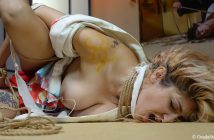
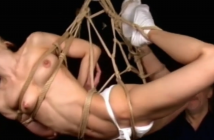
During my time as weekly guest performer at Jail Tokyo (2003-2005) I developed my own stunt by cutting the main suspension line (the one on the takatekote, 高手小手) to let the model drop from a gyaku-ebi-zuri (逆海老吊り) into a ryo-ashi-sakasa-zuri (両足逆さ吊り) (see visual above). I later added another routine to my repertoire by cutting the main suspension line of a yokozuri (横吊り) to let the model drop into a kata-ashi-sakasa-zuri (片足逆さ吊り) — single-ankle inverted suspension.

Not every woman appreciates facing death by being dropped like this nor will you find many women with enough strength to catch their own weight with one ankle alone. So, to be honest, I never did these stunts with anybody else than Asagi Ageha (浅葱アゲハ).

Considering the risks involved, I have stopped doing tsuri otosu a few years ago, and have no intention of showing these again. Likewise I strongly recommend to stay away from these stunts.


Muganawa – 無我縄
July 23rd, 2011 under From the Editor's Desk. [ Comments: 4 ]

Muga‘ (無我) is a concept steeped in the Buddhist tradition. It refers to the ‘non-self’, emptiness, or being devoid of desire. As such, it is not the first thing that springs to mind when considering shibari/kinbaku (縛り/緊縛). After all, isn’t the essence of any rope session also an exercise in desire and passion?

Before taking a closer look at muga and how it could be applied to shibari/kinbaku, let’s cast a glance backwards in time. The Chinese character can be read both as ‘nawa‘ and as ‘jo‘; essentially, the kanji expresses the meaning: ‘rope’. However, depending on context, it could also mean a bondage style or pattern. As an example of all not being quite as simple as perhaps initially thought, take the characters for ‘hojojutsu‘ (捕縄術) - the ancient art of capturing with rope. The same three kanji can also be read as ‘torinawajutsu‘. This ‘art’, in its hoshu hojojutsu (捕手捕縄術) form, has been inextricably linked with the 18 warrior skills of the Samurai (‘bugei juhappan‘, 武芸十八般). As such, it provides for several hundred years of highly advanced rope-tying techniques and represents a solid foundation for modern-day shibari/kinbaku.

Consider also the following examples, where the reading of is ‘nawa‘: 責め縄 (‘semenawa‘) - bondage geared towards torture; 首斬縄 (‘kubikirinawa‘) - bondage appropriate to beheadings; 火焙縄 (‘hiaburinawa‘) - bondage suitable for burnings at the stake; 早縄 (‘hayanawa‘) - the actual (relatively short) rope employed for initial arrests and swift take-downs; 本縄 (‘honnawa‘) - the actual (relatively long) rope used for more complicated bondage once a person has been arrested.

Returning to the fact that today’s contemporary Japanese tying methods are based around ancient Samurai martial arts (‘kobudo‘, 古武道), by extension it follows that shibari/kinbaku are similarly guided by the same principles governing all other Japanese martial arts. Further, a profound understanding of these would often have meant the difference between life and death. In this way, it is not too far-fetched to imagine that both a solid foundation in tying skills and the observance of a few time-worn principles would be the difference between a so-so bondage session and an out-of-this-world kinbaku session.

Now quickly fast-forward to muga (無我), and what it can bring to your tying experiences. Firstly, let’s contemplate what the legendary grandmaster Akechi Denki (明智伝鬼) explained to me two weeks before his death: “I empty my mind. The ideas then just come to me: from within or from the partner I’m tying. Sometimes the ropes move of their own accord and my hands simply follow, and that is always such an amazing experience. I just disappear. The shibari is always so beautiful whenever that happens.”

That elusive ‘empty mind’ also plays a fundamental role at the higher levels of Samurai swordsmanship, a principle expounded upon by Miyamoto Musashi in his Book Of Five Rings, wherein he elaborates in quite some depth upon the concept of muga - with ‘ring’ number five denoting the void, the nothingness, the emptiness of the mind.

Which brings us neatly on to muganawa (無我縄). As the active protagonist in the rope session, imagine shedding all of your thoughts, all of your desires. You do so because favorable feelings of love and empathy for your partner opposite you come to the fore now. You wish to give, not to receive. Your goal is not to satisfy your own cravings, your lust, but rather to reach a state of heightened awareness which allows you to discern and compute the subtle messages and signals emanating from that passive being now submitting before you.

If all goes to plan, you will be able to read your rope partner like an open book, developing a higher understanding of his/her needs, indeed doing so more truly than - and perhaps even before - he himself/she herself does at each particular moment, the now.

Remember, though, that, in order to correctly read your partner, you yourself must be in an objective, neutral state of mind, a state unbefuddled by false beliefs or assumptions.

In essence, a muganawa session is set apart by its emphasis upon the passive partner being allowed to reach his/her true potential rather than the assertive protagonist simply imposing his/her will.

Reaching muga is not achieved, though, by the mere reading of a book or pressing a switch. Rather, muga is reached by attaining peace of mind through an approach to your rope session that is entirely non-egotistical. Muganawa isn’t everything, admittedly, and it is not the only way to enjoy bondage. Yet, I do encourage you to occasionally give muga a shot.

Osada Steve (長田スティーブ)


Sydney’s Calling
February 3rd, 2011 under From the Editor's Desk. [ Comments: none ]

sydney_banner.jpg

Osada Steve will be conducting a series of Shibari workshops at the xplore Sydney — April 22 to 24.

Prior to and after this event several intensives, clinics, as well as private tuition will be offered. Details to be announced.


Toubaku
January 22nd, 2011 under From the Editor's Desk. [ Comments: none ]

Toubaku

The international line-up for the 2-day Toubaku event now includes two more acts that didn’t make it into the flyer on time:

Mark (and his lovely lady star) of DV8House (Australia)

Max & Tina of the Copenhagen Shibari Dojo (Denmark)

Get your advance tickets at Lawson convenience stores, Studio SIX, or the Osada Kinbaku Dojo.


Christmas Special
December 18th, 2010 under From the Editor's Desk, Video. [ Comments: none ]

Aiko DVDs

Here we go. Five hours of Kinbaku Live performances @ Studio SIX featuring none other than Aiko (愛子). The filming for these took place over the same period the Aiko book was produced.

Proud owners of the Aiko book and/or the first two Aiko DVDs (released in 2009) are entitled to receive Aiko-3, Aiko-4, and Aiko-5 at a nominal charge of JPY 2,000 each (plus JPY 1,000 each for s&h).

Yet-to-be-proud owners of the Aiko book may order this book and the 5-DVD set as a bundle for JPY 19,800 (add add JPY 7,000 for international express shipping – EMS). Offer expires January 10, 2011.

*Each DVD can also be purchased individually for JPY 4,500 plus JPY 1,000 s&h (international express). Just visit this page, click on any “Buy Now” button and send a mail stating your requirements.


Hojo vs Torinawa . . . 捕縄 vs 捕縄
February 3rd, 2010 under From the Editor's Desk. [ Comments: none ]

hojo.jpg

The guys over at hojojutsu.com and hobakujutsu.com must have caught on to something.

That “something” being that the kanji 捕縄 can either be read as Hojo or Torinawa.

Now, nobody knows how Fujita Seiko (藤田西湖) has called it — unless you are privileged to visit the great “beyond” aka that place where our maker dwells and those who used their rope () well are afforded eternal tying opportunities in Heaven.

To make a long story short, read this:


Zukai Hojojutsu by Fujita Seiko

図解捕縄術藤田西湖著

The ultimate book demonstrating the historical significance of the Japanese tying arts practiced by the Samurai warrior class.  Long out of print, this bible on Hojojutsu is a highly sought after collector’s item regularly fetching record prices at online auctions.

A limited number of unsold copies in pristine and original condition are now on sale at a special price of JPY 25,000.

This special price is bound to increase as the number of unsold copies continues to decrease. Order your very own copy now, as this may be your last chance to obtain this book at a reasonable price.

With hoshu hojojutsu (捕手捕縄術) having been practiced as one of the 18 warrior skills (武芸十八般, bugei juhappan), this book should be of interest to all students of traditional Japanese martial arts. Furthermore, as explained in the “The Beauty Of Kinbaku” (2009) by Master “K”, the more modern tying arts of Shibari (縛り) and Kinbaku (緊縛) trace their origins to this ancient and highly codified martial art, making this book an important resource to all.

Keywords

Just to demonstrate the sheer complexity of ties and concepts covered, see the following shortlist of terms culled from the first 20 pages of the book.

Hojojutsu, 捕縄術 (can also be read as torinawajutsu)

Hobakujutsu, 捕縛術

Jojutsu, 縄術 (sometimes read as nawajutsu)

Torinawajutsu, 取縄術

sokei no jutsu, 繰繋之術

togijutsu, 伽術

senjutsu, 仙術

Honnawa, 本縄

Hayanawa, 早縄

Semenawa, 責縄

hobakuyo nawa, 捕縛用縄

keibatsuyo shokei nawa, 刑罰用処刑縄

shokei yo kubikiri nawa, 処刑用首斬縄

sarashi nawa, 晒縄

ketsujo, 傑縄

hiaburi nawa, 火焙縄

gomonyo kakushu semenawa, 拷問用各種責縄

shikenyo kakushu shiyonawa, 試剱用各種仕様縄

nawakake hoho, 縄掛方法

taishonawa, 大将縄

shisotsunawa, 士卒縄

geronawa, 下郎縄

nijubishinawa, 二重菱縄 (in Ittatsu-ryu read as futaebishinawa)

jumonji, 十文字

waribishi, 割菱

chigaibishi, 違菱

kaminawa, 上縄 (can also be read as uenawa)

kaeshinawa, 返し縄

takaha/taka no hane, 鷹羽

shimenawa, 注連縄

toriikakeru, 鳥居懸

kyujunnawa, 笈循縄

chichigakenawa, 乳掛縄

chigonawa, 稚児縄

zatonawa, 座頭縄

hafujonawa, 羽附縄

ashigatamenawa, 足固縄

tomenawa, 留縄

kainawa, 介縄

okurinawa, 贈縄

watashinawa, 渡し縄

sarashinawa, 晒縄

kubikirinawa, 首切縄

kirinawa, 切縄

kirinawa/zanjo, 斬縄

hasaminawa, 剪縄

rakka, 落花

sutenawa, 捨縄

kirinawa, 伐縄

hitsukenawa, 火付縄

hininnawa, 非人縄

kaginawa, 鈎縄

heinorikagi, 塀乗鈎

harinawa, 針縄

chizomenawa, 血染縄

yokomenawa, 横目縄

shirushinawa, 印縄

royashikinawa, 牢屋敷縄

toriwa, 捕輪

orikakenawa, 折掛縄

kajaguchinawa, 假蛇口縄

fundonawa, 分銅縄

hayatejo, 早手錠

A word on kanji readings

Most Japanese kanji have more than one reading, and so do the kanji for rope (縄) and capture (捕). As a result, the kanji combination for 捕縄 (arresting/capturing with rope) can either be read as “hojo” or as “torinawa”.

To further complicate matters, the kanji for rope (縄) within the context of the Japanese tying arts as described in this book can sometimes mean “rope” in the physical sense as in hayanawa (早縄, literally meaning fast rope – the relatively short rope made for an initial arrest and temporary bondage) and as in honnawa (本縄, literally meaning main rope – the relatively longer rope used for more long-term and elaborate bondage). But, the kanji for rope (縄) often also stands for describing a certain technique or type of bondage, such as in taishonawa (大将縄 – a bondage meant for higher ranked samurai officers/generals) or in ketsujo (傑縄 – a kind of special-purpose bondage).

About the author

Fujita Seiko (藤田西湖), the reputed 14th soke of Koga-ryu ninjutsu, is not only known as a legendary martial artist but also for his research on the ancient warrior arts of the Samurai – not unlike Nawa Yumio (名和弓雄), another “last ninja” and martial arts historian.

Other books on ancient martial arts by Fujita Seiko

Zukai Shurikenjutsu (Illustrated Shuriken), 図解手裏剣術

Zukai Kenpo Gokui Atemi Sakkatsuho (Illustrated Secret Kenpo Killing Strikes), 拳法極意 當身殺活法明解

Zukai Shinto Muso Ryu Jojutsu (Illustrated Shinto Muso-ryu Jojutsu), 神道夢想流杖術図解

Note

Due to the different readings of the kanji combination 捕縄 the title of this book is sometimes also translated as Torinawajutsu.


Year of the Tiger - 寅
December 24th, 2009 under From the Editor's Desk, Media Report. [ Comments: none ]

aiko-book.jpg

There is no use to close the barn after the cows have left. So, after getting rid of that Bull (or was it the Ox?), welcome to the Year of the Tiger (寅).

Just a word of caution though. ‘Coz if you throw “tiger” into an online dictionary, you’re likely to get a very different kanji (虎) returned. Fortunately, both kanji (寅 and 虎) have the same reading: Tora. It’s also fortunate that the foreigners at the Editor’s Desk of TokyoBound have Japanese girlfriends (well, most of them) and that these gf’s have grandmothers that can be consulted about matters such as the Chinese Zodiac and things like Oshogatsu (お正月). So, before us guys put out some bull, we’d like to check our facts with “reliable” sources.

To make a long story short, Osada Steve has published an art book celebrating the Tiger (your choice of kanji here). This book is about Aiko (愛子), “she who carries the Tiger (tattoo) on her back.” There is strong evidence to suggest that this book will not just be THE Osada-ryu (長田流) book of the year, but also THE “Year of the Tiger” book of the year.

Now, rather than boring you with the ins and outs of this book, read the “blurb” by none other than Master “K”:

Just in time for the Year of the Tiger, Osada Steve (長田スティーブ), master of the elegant suspension performance, and so much more besides, has released his first book of Kinbaku (緊縛) photographs.

It’s a beautiful book. Entitled “Aiko” (愛子), it’s a handsome and sumptuous, large-size, paperback publication of 160 pages filled to the brim with beautiful color photos. The pictures are the product of eight different photographers and each has trained an avid and artistic eye on Osada Steve’s well-known performances from his Studio SIX in Tokyo. The results are often spectacular. 

The book is divided into sections devoted to different classical Kinbaku ties and techniques (Newaza - 寝技, Tsuri - 吊り, Bo/Bamboo Pole, etc.) as well as to other diversions (candles, multiple models, etc.) with each section preceded by a short page of pithy, informative and often amusing comments from the master himself.

So solid and entertaining are these commentaries that one almost wishes these were longer and more numerous. What is true is that it’s a delight to hear Osada Steve’s wise and authentic voice come through these pages. Of course, it’s the photos that dazzle and it’s a pleasure to be able to study Osada Steve’s beautiful and idiosyncratic techniques up close. Naturally, his models are very lovely and I can think of few other recent books (Yukimura Haruki’s - 雪村 春樹 - fairly recent “Akai Hana” is a rare one that comes to mind) that so beautifully present the art of Kinbaku in photographs.  Among all these lovely models, Aiko surely stands out. In fact, this book might almost be considered a Valentine to this beautiful woman. As Osada Steve writes in one of his chapter introductions: 

“A smile from aiko-chan will set your heart on fire. A touch from her will make you melt like ice.” 

Lucky is Steve to have such a partner. On the other hand, lucky is she to have so skilled and devoted a rope master. One who is extremely talented but also humble and caring and one who knows that, as the late Akechi Denki (明智伝鬼) sensei once said, “Kinbaku is an activity for two like-minded hearts and must always be a loving exchange.” And lucky are we who can share in this loving partnership through this handsome book. 

Master “K”

Now, supposing you have read this far and are contemplating to own this book or gift it to your significant other, AND you haven’t yet clicked through, here come the text parts the book. (Sorry, to get a taste of the photos inside, you gotta click thru.)

Table of Contents

Introduction…3
Newaza (Floor work) – 寝技…4
Tsuri (Suspensions) – 吊り…32
Yokozuri – 横吊り…34
Aomuke-zuri – 仰向け吊り… 50
Gyaku-ebi-zuri – 逆海老吊
… 54
Ebi-zuri – 海老吊り…58
Futomomo-zuri – 太腿吊り… 62
Utsubuse-zuri – 俯せ吊り… 68
Semenawa – 責め縄… 76
Teppo-zuri – 鉄砲吊り… 78
Takezuri – 竹吊り…84
Kazari Nawa – 飾り縄…86
Bo Shibari – 棒縛り… 96
Miscellaneous… 100
Tongue play – 舌責め…132
Candle Play – 蝋燭責め…136
Happy Moments… 142
Double Trouble… 148
Cage Play… 154
The Last Page…158


Introduction

This book is all about aiko-chan.

All photos (with the exception of the Double Trouble series) were taken during Kinbaku Live performances at Studio SIX Tokyo. These sessions are intense and intimate affairs where visitors are afforded a chance to take photos and/or shoot video.

Regular Kinbaku Live performances are held twice a week (Wednesdays and Saturdays), lasting for about four hours, entailing four or five sets each. On other nights Studio SIX is available to photographers and private collectors who are after those special looks that only a live session (aka play session) can provide. In other words, what you get at Studio SIX is the real deal with real emotions as opposed to staged poses.

Since 2002, I must have held about 600 such events, running through well over 100 models.

Kinbaku Live sessions are different from my Shibari Shows on bigger stages or in so-called nude theaters around Japan. The latter have strict time limits, and no photography is allowed. Shibari Shows in theaters are usually put on four times a day, ten days in a row. As such they can be quite taxing on the stamina of the model and on my own vigor. My record to date is 400 such shows in a single year.

Physically speaking, Studio SIX doubles as Osada Kinbaku Dojo where special Shibari Clinics are conducted, where foreign Shibari students can stay during their training, and where expat residents and local Japanese Shibari enthusiasts receive training in Osada-ryu (長田流).

But back to aiko-chan who, over the course of 18 months, has become somewhat of a star at Studio SIX. The photos for this book were selected from approx. 25 shoots by eight different photographers.

Osada Steve
長田 スティーブ

Newaza (Floor work) 寝技

Newaza loosely translates to floor work. The techniques heavily draw on what I have learned from grandmaster Yukimura Haruki (雪村 春樹), the undisputed King of Newaza, the foremost proponent of the so-called caressing style of Kinbaku.

As a rule, each Kinbaku Live session at Studio SIX starts on the floor for several reasons: a) to get a feel of the model’s condition (m-jo no jotai – M女の状態) on that particular night, b) to substitute “negotiation” by getting a feel of the type of the person I tie – especially with a new model – in which case the newaza (寝技) is what I call aisatsu (greeting – 挨拶) shibari, c) because newaza techniques are ideally suited to develop closeness, intimacy and a deep emotional exchange between two partners, and d) because I really like newaza – in fact, depending on the mood, I might just stay on the floor for the entire Live night, foregoing suspensions altogether.

Newaza is closely related to shuuchinawa (羞恥縄). This term is difficult to translate, as are many other Japanese concepts, because not only the language is different, but also the cultural backgrounds and the way the Japanese think. Shuuchinawa is a tying style where the bakushi (縛師) utilizes the inherent shame of an aroused woman to emphasize her reactions to achieve those special emotional and erotic facial expressions for which Japanese bondage images are famous for.

What happens in a shuuchinawa session is that the woman struggles with her own erotic arousal – as in: shall she be ashamed to admit her sexual desires, or shall she let go completely? Japanese women are prone to finding themselves in such predicament.

Tsuri (Suspensions) – 吊り

Suspensions within Shibari/Kinbaku are mainly part of semenawa (torture bondage – 責め縄). Not necessarily to act out torture scenes, since in my own case I am trying to tie for maximum comfort. Semenawa in this context means that the ties are very precise – as opposed to merely wrapping rope around somebody. The most highly recognized master of this genre is the late Akechi Denki (明智伝鬼).

Given the increased risk of nerve damage and serious injury, the ties need to be well designed and applied with high precision. Especially for suspension progressions there is no margin for error.

Having studied under Akechi Denki for several years, and later under Nawashi Kanna (縄師神凪), Akechi Denki’s main disciple, I follow semenawa principles when doing suspensions.

Yokozuri (Sideway Suspension) – 横吊り

Yokozuri is one of my favorites. To date I have done these in one form or another well over a thousand times. The beauty of yokozuri is, if based on a solid takatekote – more precisely on the 3-rope Osada-ryu takatekote (長田流高手小手) purpose-built for yokozuri – it can be applied to any person, male or female, young or old, of any size and weight.

Yokozuri offers a multitude of variations and progressions, more than any other type of suspension. Most of all, it isn’t taxing on the lower back (as in a Gyaku-ebi-zuri, see pp 54), and it offers mid-air poses of pure grace without discomfort or pain. In short: to enjoy and gracefully float in mid-air, you don’t require a trained or professional model.

The above notwithstanding, it obviously helps if the model is experienced and knows how to shift and distribute her own weight in an almost dance-like aerial performance.

Aomuke-zuri (Face-up Suspension) – 仰向け吊り

Aomuke-zuri is ideally suited for various suspension progressions – the most common being a face-up horizontal to the floor that then transitions to an inverted suspension (sakasa-zuri – 逆さ吊り). The latter could have a waist rope (do-nawa – 胴縄) as its main support, or ropes at both ankles (ryo-ashi sakasa-zuri – 両足逆さ吊り), or one ankle alone (kata-ashi sakasa-zuri – 片足逆さ吊り). And, of course, if you want to get fancy, you might construct some sort of hip harness to take off some or all of the load from there.

The takatekote as a base for an aomuke-zuri could be a tasuki (襷) or a hishi-nawa (菱縄) variation, but other forms of main upper-body support are possible and available.

Floating horizontally to the floor will make it difficult to hold the head up, causing the neck to do some extra work. Therefore this position should not be held for too long.

Gyaku-ebi-zuri 逆海老吊り
(Reverse-Shrimp Suspension)

Statistically speaking the gyaku-ebi-zuri is the most common type of suspension seen in Japan. At first glance it looks easy to construct, as all you need is a suspension line on the takatekote (高手小手), then lift the legs up one at a time. For this reason it is the bread-and-butter tie of female rope workers (shiroto jo-osama – 素人女王様) whose bondage skills are limited. Subsequently this is also the suspension with the highest rate of nerve damage and other injuries.

Due to the high risk of nerve damage, the takatekote should be constructed very carefully. To do so requires a very experienced person. According to Nawashi Kanna sensei, the gyaku-ebi-zuri is the most difficult type of suspension to do safely.

A common “stunt” that can be seen in bars and clubs around Japan is for the suspended rope bottom to be mounted by her top and used as a swing (buranko – ブランコ). The subsequent damage to the spine and lower back (especially when done on a daily basis over a period of several years) will be long term. I personally know one woman who suffers from chronic back pain, having spent thousands of dollars in hospital bills and acupuncture treatment so far.

Of course there are techniques to mount and swing without applying your full weight onto the back of the suspended sub. Tops with fingers of steel could theoretically hold their own weight. Or the top could step on the suspension lines rather than on the body of the sub. The latter, of course, requires a solid and well-designed bondage, a little bit of extra thinking, and some sort of acrobatic ability on the part of the top.

With a never-ending stream of fresh rope bottoms coming online, and those rendered invalids going offline, the cycle continues. It is the shiroto jo-osama, that give the entire Shibari/Kinbaku genre a bad name.

Utsubuse-zuri – 俯せ吊り

I am sure this type of suspension has been done by others in the past, though I have no recollection of having seen this before. In other words, I am also not aware of any established or non-established name for it.

Utsubuse means lying face down. I chose the term utsubuse-zuri, because the lift-off for this suspension is taking place with the sub lying on the floor, face down.

The tie itself is fairly simple. The general idea is to distribute the tension/weight between the chicken-winged legs and the hip rope (koshinawa – 腰縄). So at the end of the day the success of such a suspension depends on the model – more precisely, whether the rope bottom is able to withstand the pain.

This is one of several suspensions that requires a bit of training on the part of the model.

Semenawa – 責め縄

As I mentioned earlier, it is my policy to tie for maximum comfort. However, there are ties that by definition cannot be comfortable.

Now here you have it, a suspension by the wrists and ankles that is sure to be painful and apt to freak out your average sub.

Teppo-zuri – 鉄砲吊り

Teppo is Japanese for firearm. The arms in this suspension form a pattern similar to a person carrying a rifle on his back.

There are several variations of this rather complicated suspension. The legs could be suspended on the upper suspension point (to take off some tension from the upper body lines), or they could be hooked into the waist rope. The heels could be placed both behind or one leg could be in front, creating some sort of “runner’s” (飛脚) pose.

Due to the complexity of the tie, the construction before lift-off takes more time than your average takatekote. Suffice it to say that the bondage on the arms and upper body needs to be a snug fit in order to avoid grief along the line.

Due to the very strict tie and basically uncomfortable position of the arms, it makes for good practice to do the bondage fast – and also to untie it fast.

My recommendation is, if you are not experienced enough to construct the base teppo position fluidly and speedily, do not attempt lift-off. Rather spend a few years practicing other ties, before attempting this.

One of the risks with this bondage is straining/pulling muscles in the upper arm of the arm that is raised. Another risk would be breathing problems if the base bondage restricts the rib cage and diaphragm areas.

The beauty of this suspension is that the rope bottom is in a position perpendicular to the floor.

Of course other suspension forms based on the same tying principles are possible/imaginable. For example having both elbows raised above the head, resembling a bunny – in which case I would call this suspension an usagi-zuri (兎吊り).

Take-zuri (Bamboo suspension) 竹吊り

Take stands for bamboo, and zuri (or tsuri) stands for suspension.

As happens with many names for Japanese ties they are mainly descriptions of what is going on. To complicate matters, one bakushi may call a certain tie one way, while another bakushi might give it a completely different name.

Take-zuri simply means bamboo suspension, or, within this context, a suspension of a person while utilizing bamboo. Such bamboo could be anywhere. For example, the bamboo could be fixed to the outstretched arms of the rope bottom (see Bo Shibari on pp 96), or it could simply have a decorative function without any load-bearing task.

So to be precise, the bondage shown here could be called “hollow-of-the-knee(s) hanging on a bamboo pole suspension” (ryo hiza no ura take-zuri – 両膝の裏竹吊り), but that would lead to long-winding names and there would be no end of it.

My favorite term is yukata shibari, which merely means bondage with someone wearing a summer kimono. In other words, this name doesn’t say anything about the actual type of bondage. For one-upmanship one could create names like “yukata shibari with the rope bottom having pierced earlobes and a tattoo (specify type) on her left thigh (or whatever other place)”.

Kazari-nawa (Macrame Bondage) 飾り縄

Kazari-nawa is an important part of Shibari, because whenever you have completed the working part of a certain tie and find yourself with excess rope, it is time to put those loose ends away intelligently – and in a way that follows Japanese esthetics.

What you find in this chapter are ties specifically meant to demonstrate kazari.

Bo Shibari – 棒縛り

The Japanese are fond of images where a person’s arms are tied to a stick/pole. They can be found in Kabuki plays as well as in modern slapsticks on TV.

One fairly popular application of bo shibari is where two servants are being tied into these positions by their master so as to prevent them from drinking precious wine during his absence. This is always good for a few laughs in theaters and on TV when the two servants struggle to uncork (and drink) a bottle of liquor – failing to do so at first, until finding a way to cooperate until passing out under the kitchen table.

Miscellaneous

Now here is a word that deserves entry into a spelling bee contest.

What you will find in this chapter are photos that defy categorization. Consider them bonus pictures simply meant to provide some additional eye candy.

Tongue play – 舌責め

A well-trained tongue can give as well as receive pleasure. At times it even finds itself at the receiving end of torture.

Now aiko-chan happens to own one of the sexiest tongues around, and it simply seems natural to take full advantage of that asset whenever the opportunity arises.

Candle Play – 蝋燭責め

Candle play may at first glance appear harmless enough and easy to do. However, there are a few pointers that would come in handy.

As with most SM plays, it helps to know what you are doing and to develop a certain amount of technique (gijutsu – 技術).

First, candles burn at different temperatures, mainly dependent on the amount of paraffin they contain. It’s also obvious that the distance the dripping wax travels will to a certain degree affect the hotness upon impact on the skin.

In terms of safety it makes for good practice to keep the flames away from the body (hair might get singed) and other material that can catch fire. For example, in Japan it is a common sight to stick a number of candles into the suspension lines, creating some sort of Christmas tree effect. Every once in a while there are reports that suspension lines have caught fire which then caused the rope bottom to drop.

Special care should also be taken to protect the eyes of the sub when applying wax to the face.

Candle play does make for some good yelping sounds from the sub. It also makes for nice red wax patterns on alabaster skin. On the down side it leaves a terrible mess and is a sure way to lose a maid. This is why you won’t see much candle play at Kinbaku Live @ Studio SIX.

Now, if time is up and the necessity arises to extinguish your candle(s) – which might be one or two or even one or two “dynamite sticks” containing half a dozen candles each – you might have the extraordinarily bright idea to do so on the skin of your sub! There are basically two ways to do that safely. One way is to hit the candle(s) on that “cover” of wax you created. Another way is to use the snuff-out method where the flames are killed before you hit the skin. The latter requires an even “burn” of the candle, where the wick is basically surrounded by the candle wax and thus the flame is “suffocated” before it touches the skin.

I recommend you practice this on your own skin to assure that you do not cause candle burns. Such burn marks are neither a pretty sight, nor will they disappear (like rope burns) within a reasonable time.

Happy Moments

Everything is a matter of taste. In the case of attraction to the other sex, imprinting plays a role, as do other early-life experiences. In other words, a lot is going on that is hard to put a finger on. So at the end of the day, if someone falls in love, there is nothing much you can do about.

Little aiko-chan’s voice (especially when she yelps like a puppy) evokes sounds of angels singing in heaven. Her skin temperature will make you shiver like you have never shivered before. She tastes like honey. She moves like a goddess. Her natural body fragrance makes your olfactory senses go wild. Her demeanor is that of a willing servant. Her classy style is that of a woman born to an aristocratic family. But most of all, she is the most beautiful woman on Earth.

Blessed is the man who she chooses to share her precious time with. Because such man will get a taste of paradise before his time is up.

A smile from aiko-chan will set your heart on fire. A touch from her will make you melt like ice. Aiko-chan wields immense power over men. Yours truly not excluded.

Aiko-chan is the type of woman that make a man wish to die rather than lose her.

Double Trouble

This is the only photo series not part of a regular Kinbaku Live @ Studio SIX.

The idea was to do a swing (buranko – ブランコ) shot, where one model sits atop another in suspension. (As the bamboo is positioned between the main and leg suspension lines there is zero extra force being placed on the suspended woman.)

This being a lazy Sunday afternoon, I couldn’t resist to also suspend juli-chan and aiko-chan side by side in a futomomo-zuri (also see Futomomo-zuri on pp 62).

Cage Play

I got this cage from QuickCage.de – mainly to utilize it in some of my video work. However, this being a piece of excellent German workmanship, I have developed a fondness for this cage, and it is now a standard feature at Studio SIX Tokyo. Especially since it can be assembled or disassembled in less than five minutes.

Cage play offers various opportunities like locking away someone precious for safekeeping or depriving naughty subs of their freedom – be it to punish, torture or merely letting them reflect on their own state. The possibilities of play are endless and only limited by your imagination and that of the woman at the receiving end.

Since having installed this cage at Studio SIX, I have noticed that certain subs are prone to enjoy being caged.

As we are at the homestretch of the photo series in this book, I’d like you to view the pics from the perspective of me locking away one of the most precious subs that I have ever had a chance to lay my hands on.

May aiko-chan be safe until her release, so she can be bound and pleasured some more.

The Last Page

Thank you for having reached this page. We hope you have enjoyed our very personal, little journey into Shibari/Kinbaku and SM.


Kinbaku (緊縛) Light @ Studio SIX Tokyo
May 10th, 2009 under From the Editor's Desk, Studio SIX Report. [ Comments: none ]

toe-1.gif

Old hat: Kinbaku Live Nights @ Studio SIX have received some kind of a cult following since unleashed to Shibari enthusiasts nine years ago. Judging by the high frequency of “gaijin” attendants, it has also caught up with the international JapanRope jet set.

Fresh hat: Succumbing to popular demand, Studio SIX is now offering a Kinbaku Light version on Wednesdays. The “light” means that the lights will shine brighter, though the pockets will be less light, as entry is not the usual $150 but a paltry $80 — assuming that 1 cent US trades as 1 yen JP.

Wednesday nights will on occasion feature “specialty” subs, a euphemism for models too edgy to present on Saturday nights. Like subs that crave for a fix of pain or are in need of some other “special” attention that would leave non-abnormal visitors puzzled — to put it mildly.

When in town, be sure to check it out. What you’ll get is unadulterated rope action plus alpha — for a fraction of Saturday prices.

Also check here for details.


The Beauty Of Kinbaku — by Master “K”
January 3rd, 2009 under From the Editor's Desk, Media Report. [ Comments: 4 ]

The Beauty Of Kinbaku
(Or everything you ever wanted to know about Japanese erotic bondage when you suddenly realized you didn’t speak Japanese.)

To get this book for yourself, click here.

Osada Steve

And here comes my review of this must-have book:

Master “K” has done it again! This book is a masterpiece. The mother of all books on Kinbaku/Shibari. It’s the yardstick with which all future books on the subject will be measured.

Not even in Japan do they publish such comprehensive, all-encompassing work. The author has spent years researching original sources, checking facts, translating rare documents, and interviewing key figures. The result is a sensational book that will forever change how Westerners view Shibari.

This book is such an interesting read and offers such a wealth of information, that its appeal reaches far beyond the rope community.

Right from the start Master “K” mesmerizes the reader by Read more »


Grandmaster Osada Eikichi (長田英吉) – 7 Years After
September 12th, 2008 under Behind the Scenes, From the Editor's Desk, Interviews. [ Comments: 8 ]

Grandmaster Osada Eikichi (March 15, 1925 to September 12, 2001) passed away seven years ago on September 12, 2001. Technically speaking, with Japan being the Land of the Rising Sun, this coincides with 9-11, at least for our North American fans, making it a date easy to remember.

Dubbed the Flying Rope Man by the Tokyo Journal in 1999, the legendary Osada Eikichi is generally recognized as the fastest rope artist ever.

Here’s a short interview with Osada Steve about his sensei.

TieBreaker: When and how did you first meet Osada Eikichi?

Osada Steve: I first met Osada sensei in 1998, while producing a series of Tokyo Underground features for Read more »


« Previous entries