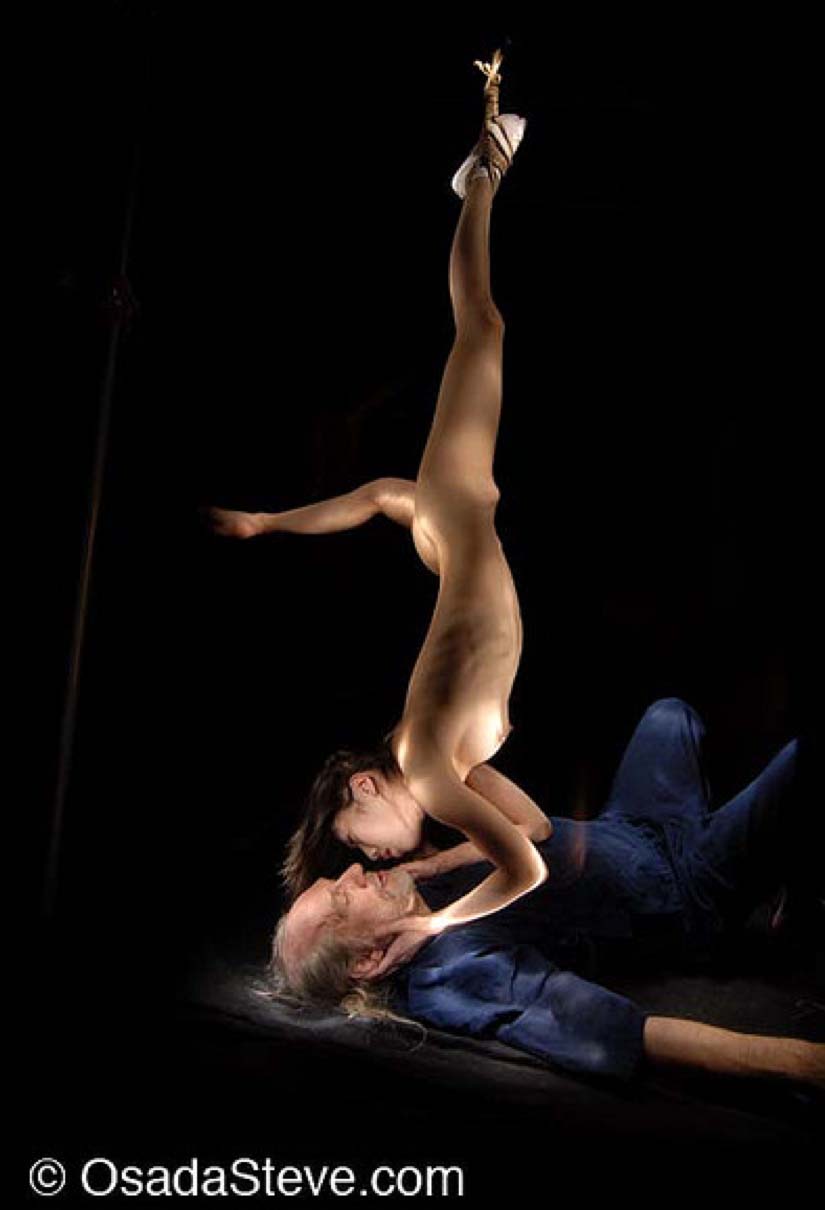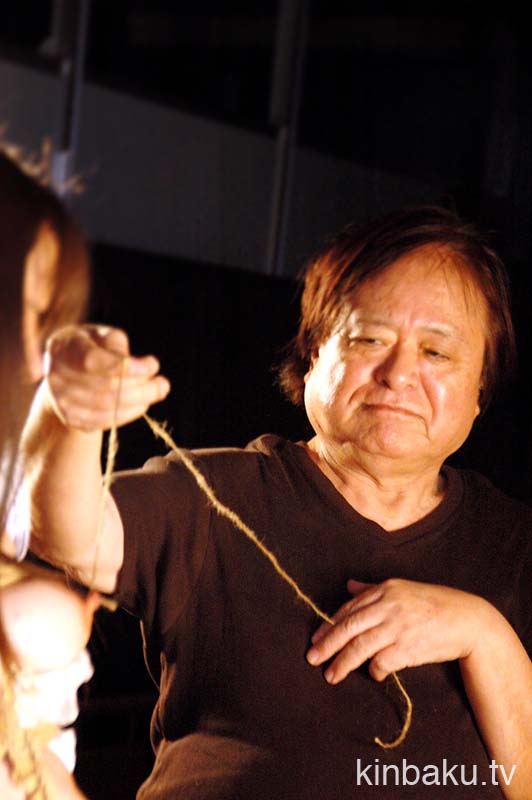
header image
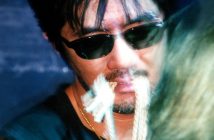
Akechi Denki (明智伝鬼), Sep 11, 1940 — July 17, 2005
July 16th, 2011 under Interviews. [ Comments: none ]

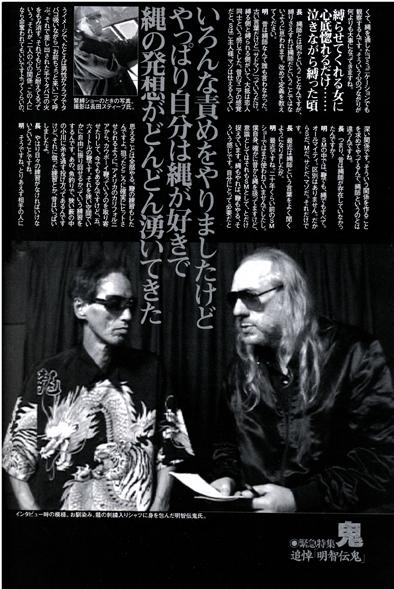
The following is an interview with Akechi Denki (明智伝鬼). It was conducted by Osada Steve (長田スティーブ) back in July, 2005, two weeks before the grandmaster passed away.

The interview was published in SM Sniper magazine (now defunct), in FetishJapan magazine (Osada Steve’s own publication), as well as in a number of foreign media.

Today’s repost is of triple significance. Firstly, it marks the sixth anniversary of Akechi Denki sensei’s death. Secondly, the interview is the last time where the grandmaster shares his thoughts for the record. Thirdly, sensei’s very last words touch on the muga (無我) aspects of shibari/kinbaku (see last paragraph of this interview highlighted in red), and it couldn’t have been said more beautifully.

Akechi Denki Osada Steve: Japanese rope bondage is getting very popular in the United States and Europe and people want to know more about it. In the West there is something I call “bedroom bondage” — you tie the wrists and the ankles with very simple bonds and when your partner is restricted you begin with sex or SM play. But that’s different from Japanese rope bondage. How would you define shibari (縛り)? What is shibari to you?

Akechi Denki: In SM, shibari is communication between two people using the medium of rope. It’s a connection made with rope between the hearts of two people. So the rope should embrace with love, like the arms of a mother embracing her child. The submissive has placed her entire trust in you.

The most important thing is never to cause physical injury to your partner. There are delicate tendons and nerves in the body and you have to be very careful never to damage them. If you tie someone up too tightly you might damage nerves. And if you don’t make your ties tight enough a rope can slip and catch on your partner’s shoulder or neck. It’s hard to believe that a single piece of rope could cause permanent damage but there have been many such accidents. You need to check your partner constantly and make sure she’s all right. Not with words but by checking her expression.

Yet almost all nawashi (縄師) wear sunglasses, particularly when they are doing shows. If your model can’t see your eyes, is she really able to communicate with you?

Communication is about much more than eye contact. You put your arms around her to see how she is doing, or you do something to her and judge her reaction. It’s really full-body communication. It can be very frightening to be tied up, to lose your freedom. You have to have good communication in order to make the person you’re tying feel safe. You want her to feel good.

What about the term nawashi? I think people in the West tend to mistakenly believe that there is some kind of qualification process before you can become a nawashi. When did that term come into use?

Maybe thirty years ago. Before that, no one used the term nawashi. When I started doing SM shows, everyone said sado (from the word “sadist,” to indicate the dominant) and mazo (from the word “masochist,” to indicate the submissive). In those days, the SM world was much smaller and people within it took their relationships very seriously. The sado was the master; the mazo was a willing slave to him. He might call her over and put his cigarette out on the palm of her hand, and that was accepted within the context of their very deep relationship. It was accepted that he could hurt her; that she was willing to give her very life to him. It wasn’t until later that people began to use the term nawashi for someone who did rope bondage as part of SM shows.

So how does someone become a nawashi? How did you become a nawashi?

You have to understand that people like me, the old generation, started doing this in our teens. We got hold of SM magazines like Kitan Club (no longer published), and then we would try to imitate what we saw in the magazine, which was much simpler rope work than what you see today. And we practiced a lot. Not just rope but all the skills we used in SM shows. I had a five or six meter whip from America — a real cowboy whip. I used to practice for hours, throwing it again and again until I learned how to cast within a confined space and be able to hit with accuracy. We gained experience through repeated practice.

But the most important thing is having a partner with whom you share a deep, trusting relationship. That was the hardest part for me — finding partners. Forty years ago, you couldn’t just come out and say you were interested in SM. There were no SM clubs where you could go and find a woman who wanted to be tied up. So I would meet a regular girl and begin a regular courtship, taking her to coffee shops and the movies for six months or even a year, forming a very deep relationship before I even dared to bring up the subject of bondage. And even so, most girls would be shocked and horrified when I brought out a rope. They’d leave me immediately. Finally, one said, “Ok, but just a little.” I was so grateful I was crying as I started tying her. I would have done anything for her. It was like finding a precious jewel.

How old were you then?

Sixteen or 17. I remember because in those days, you weren’t allowed to go into kissaten (coffee shop) until you were 18. That first girl worked as a waitress in a kissaten. And that first time, we went to a place like a dormitory. I had a weak digestive system so I always wore a sarashi and that’s what I used to tie her up. (A sarashi is a long thin cotton cloth that is wrapped around the belly because Oriental medicine teaches it is important to keep the internal organs warm.) Since I always wore a sarashi, I was always prepared if I got an opportunity for bondage.

Very convenient!

Yes, and not just for bondage. Having a sarashi wrapped around your middle could protect you in a knife fight by deflecting or stopping the blade. And if you did get cut, the cloth helped stop the flow of blood. In those days, I worked at construction sites, which were pretty tough places. I was in charge of about 100 people but I knew I wasn’t a good fighter so I kept loyal people close around me. And I wore the sarashi.

Are you completely self-taught? Did you learn rope from someone?

No one taught me. But I did become friends with Tsujimura Takashi, whose work appeared in Kitan Club in those days, and his friend Yamamoto Issho. They were based in Kansai (Osaka) but we would meet when we could and practice bondage together, and lend each other our partners.

How about the famous artist Ito Seiyu (1882-1961)? Did his photographs and paintings of women in bondage influence you?

Not really. I have collected books of his art but he explored many subjects besides shibari such as traditional ghosts. I appreciate his work as art rather than inspiration for my own work.

I understand you have done a lot of research on hojojutsu, which is an ancient form of martial arts using rope.

Yes. Because I was so interested in shibari, I went to various libraries and museums looking for information on the use of rope as a weapon. In a very specialized book on martial arts — I forget the name — I found diagrams for three examples and I studied those carefully. I learned some good techniques in this way, but rearranged them when I used them in my own work. The remaining hojojutsu schools closely guard the ancient techniques and I didn’t think they’d tolerate their techniques appearing in SM magazines.

In the Sengoku era (about 1478-1605), warriors carried rope as a weapon. If you lost your sword, you could grab your rope and use it to deflect your enemy’s sword. You could toss your rope like a lasso to catch your enemy’s sword or put weights on both ends of a rope and throw it so it wrapped itself around your enemy’s body to immobilize him. Or around his neck to strangle him. I’m afraid much of that knowledge isn’t being passed on.

But some modern police and military forces use similar techniques. The Italian and US special forces use rope for securing prisoners, tying it around the waist and then securing both thumbs. It’s simple but very effective and cheaper than handcuffs. I’ve heard that they learned this technique from traditional Japanese martial arts, and that the rope they use is very good.

I also researched the techniques of the Edo period police force. The constables had different ties depending on the status of the person they were holding, and they developed different ways of tying prisoners depending on how they were to be transported. For example, if prisoners were being sent by boat to the penal islands, they wanted to leave the legs free so prisoners could get to the side of the boat if they became seasick.

What I really appreciate is that you are always so supportive and positive. I’ve come to you to learn certain ties and even when my efforts came out terrible you praised me. You’re like that with everyone. You never say, “Oh, that guy can’t tie at all.” You obviously just love rope and love to see people doing shibari. I think that’s why you’re so well-liked and respected in the SM world.

I remember what it was like when I was just starting out.

One last question: there are very few professional nawashi, and each has a distinctive style. Your style is very intricate and beautiful. How did this develop?

For me, the most important thing is that the rope work look good. My style developed in the course of stage shows, at a time when there weren’t yet videos. I felt it was important that I give the customers something unique, something they hadn’t seen before. So I had to develop my own style; the ideas had to come from within me. And my goal, my driving principle, is never to do the same tie twice. Of course, sometimes I do end up repeating myself but in my mind, I’m always trying to do something completely new. So even now, my style is still changing and developing.

When I get on stage at the beginning of a show, I don’t have any ideas about what I’m going to do. I empty my mind. Then the ideas just come to me, from within or from the partner I’m working with. Sometimes the ropes move on their own and my hands just follow, and that is always an amazing experience. I just disappear. The shibari is always very beautiful when that happens.


Akechi Denki Interview – 1997 — 明智伝鬼
November 20th, 2009 under Interviews, NuitdeTokyo. [ Comments: none ]

tsukasa-shobo-09.jpg


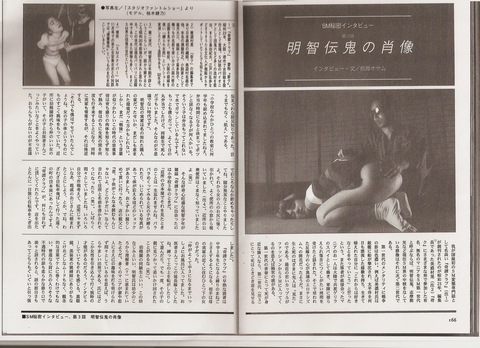
The following interview is from volume 6 of SM 秘密俱楽部 (SM Secret Club) published in 1997. It used to be a relatively minor player within the Tsukasa Shobo Publishing portfolio - ranking behind magazine titles like SM Fan and SM Frontier, that left their mark on Showa era SM publishing.

After a messy change of ownership, Tsukasa Shobo went bankrupt in 2007. The interviewer for the article signs as Tajima Osamu, a fairly common name. An internet search hasn’t come up with any other SM-related works under that name.

Interestingly enough, the article includes mention of Osada Seminar pioneered by Osada Eikichi Shi.

Thanks to NuitdeTokyo (NdT for short) we can bring you now the English translation of this interview. Next to Master K, NdT is probably the most avid collector of Japanese SM literature. In the past, NdT has discovered another Akechi Denki interview (from ca. 1976) and kindly shared it with us here.

For those unfamiliar with the who’s who’s of the Japanese Shibari and Kinbaku world, both Osada Eikichi (長田英吉) and Akechi Denki (明智伝鬼) are considered grandmasters of the art - the former having passed away in 2001, the latter in 2005. The probably last ever interview with Akechi Denki Shi was conducted by Osada Steve (長田スティーブ) for Steve’s own magazine, Fetish Japan, and for SM Sniper, one of the largest surviving SM magazine players, until it folded in January 2009.

Before we now get to the actual story, a few words by NuitdeTokyo: Read more »


Demon SIX talks to Osada Steve (長田スティーブ) of Studio SIX
October 31st, 2009 under Interviews. [ Comments: none ]

asagi-ageha.jpg

Earlier this year, Osada Steve (長田スティーブ) had the honor of being interviewed by Demon SIX (no relation to Studio SIX) who is not only a prominent figure at Fetlife but also a privileged member of the inner circle of Master K (no relation to Circle K). The interview first appeared in the Kinbaku Group on Fetlife.

What got you started in Kinbaku (緊縛) ?

I have had three rope bondage phases in my life.

So-called Western: From kindergarten to 1997, when I tied every woman I could lay my hands on.

Shibari (縛り): From 1998 to 2006, when the late Osada Eikichi Sensei first took me under his wings, and I then continued to train under the late Akechi Denki Sensei for about four years, followed by studies with Nawashi Kanna Sensei.

Kinbaku (緊縛): Since 2007, when I embarked on learning Shuuchinawa (羞恥縄) and Newaza (寝技) techniques under Yukimura Haruki Sensei. It is since phase III that finally all the pieces are coming together, starting to make sense to me.

In my line of work I make a clear distinction between Shibari and Kinbaku. You could say it took me eight years to get a grasp of Shibari, and I’m in my third year of trying to crack the mysteries of Kinbaku.

In any case, were it not for the unique window of opportunity, the fortuitous event that Osada Eikichi Sensei chose to make me his prodigy, I would Read more »


Akechi Denki (明智伝鬼) — Untie Speed Is King
January 26th, 2009 under Interviews, NuitdeTokyo. [ Comments: 5 ]

Akechi Denki

Alert reader NuitdeTokyo has sent in the following interview with the late grandmaster Akechi Denki. What makes this contribution so special is that the interview first appeared more than 30 years ago in a little-known magazine called Venus (now defunct).

NuitdeTokyo reports: Inspired by the extensive bibliography in Master K’s recently released book “The Beauty Of Kinbaku” I found myself bargain hunting for rare books and facsimile in downtown Tokyo, when I came across this little magazine. It featured a very sexy vanilla cover, but the inside was exclusively SM content. This issue of Venus is probably from around 1976, and to my delight it carried an interview with Akechi Denki at a time when the full talent of the maestro was yet to be discovered; at a time before he had started doing public performances – yet was already active for 20 years in the Shibari scene.

***

In Shibari Untie Speed Is King

Why private play and public performances aren’t the same

In this article, we are introducing Akechi Denki a master with more than 20 years of SM history. Now in his late thirties, while managing his own business, he is working as a nawashi, acting as adviser for shows.

“My very first interest in SM was sparked when I was in the Read more »


Naka Akira (奈加あきら) Interview
November 22nd, 2008 under Interviews. [ Comments: 6 ]

 akira-naka.jpg

Back in 2006, Osada Steve had the honor to interview Naka Akira, one of the younger Nawashi at work in Japan today. What follows is an English summary of their discussion.

Osada Steve: Please tell us how you first got interested in Shibari.

Naka Akira: They say that everyone has a turning point in their lives. I’ve had two. The first was when I was about 30 and running a porn model agency. One of our actresses was doing work for Cinemagic, a well-known SM video production company, and I happened to attend one of her video shoots. Although I thought I had absolutely Read more »


Nureki Chimuo (濡木痴夢男) Interview
October 7th, 2008 under Interviews. [ Comments: 1 ]

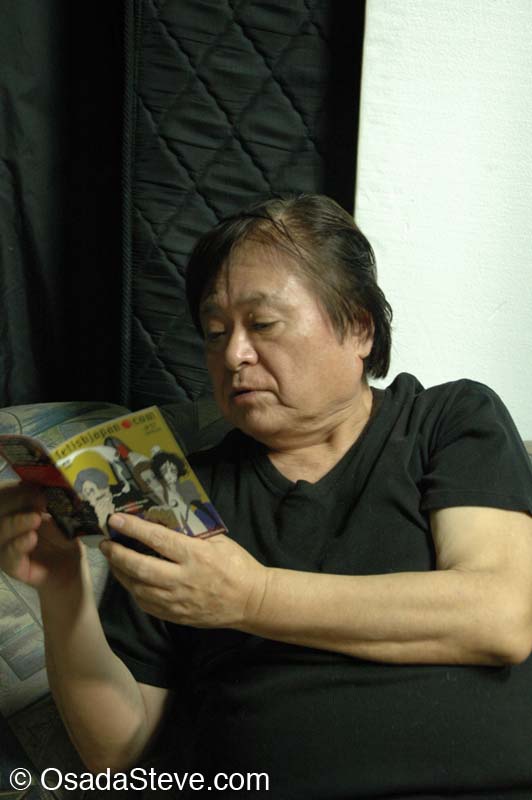
Nureki reading FetishJapan mag

This interview with Shibari grandmaster Nureki Chimuo dates back to 2006, when Osada Steve took international video artist Hito Steyerl on a Tokyo tour for her video installation Lovey Andrea at the Documenta 2007.

Nureki Chimuo is also featured in the recently released Bakushi movie together with grandmaster Yukimura Haruki.

Rope is what the doctor ordered

by Osada Steve

Just as maverick photographer Nobuyoshi Araki claims to have been born with a lens on his nose, veteran Kinbaku grandmaster Nureki Chimuo too has an interesting story to tell: “I did my first bondage tying up the nurse with my umbilical cord,” he reveals. It’s only natural that geniuses get started early in life. Neither Araki nor Nureki, so it seems, chose their craft. Rather, their craft chose them.

Having tied about 4,500 women to date, Nureki is by a wide margin Read more »


Grandmaster Osada Eikichi (長田英吉) – 7 Years After
September 12th, 2008 under Behind the Scenes, From the Editor's Desk, Interviews. [ Comments: 8 ]

Grandmaster Osada Eikichi (March 15, 1925 to September 12, 2001) passed away seven years ago on September 12, 2001. Technically speaking, with Japan being the Land of the Rising Sun, this coincides with 9-11, at least for our North American fans, making it a date easy to remember.

Dubbed the Flying Rope Man by the Tokyo Journal in 1999, the legendary Osada Eikichi is generally recognized as the fastest rope artist ever.

Here’s a short interview with Osada Steve about his sensei.

TieBreaker: When and how did you first meet Osada Eikichi?

Osada Steve: I first met Osada sensei in 1998, while producing a series of Tokyo Underground features for Read more »


Miura Takumi (神浦匠) Interview — The Path of Tradition
May 18th, 2008 under Interviews. [ Comments: 2 ]

The latest in our series of unique and insightful interviews with the top shibari masters. This interview of Miura Takumi was conducted by Osada Steve and represents another in a line of interviews at TokyoBound which are as illuminating as they are rare. — KJ

Osada Steve: You’ve been doing shibari for about 15 years, the last seven years as a professional nawashi. What is it about shibari that interests you so much that you are devoting your life to it?

Miura Takumi: I was first attracted to shibari because of an interest in Read more »


Esinem Rocks Tokyo
February 8th, 2008 under Interviews. [ Comments: none ]

Esinem plies his trade in the UK and the EU and has made it to the Far East now on two different occasions. He just finished up an intensive course with Osada Steve and also managed to squeeze in some visits to various SM live shows and events as well as to the lairs of Tokyo’s cruelest mistresses. But those things were nothing compared to an ordinary-looking Korean restaurant in Shin-Okubo. — KJ

KABUKIJOE: I guess this was your second visit to Tokyo. When did you come the first time and what did you do on that occasion?

ESINEM: My first visit was last year for a month from late April to late May and was for a combination of reasons. Firstly, to fulfill a long held ambition to visit Japan, which has fascinated me for a long time. I was able to see a little of the country including Kobe, Kyoto, Osaka, Nikko and Hiroshima, culminating in a two-week stay in Tokyo. Fortunately, I have friends here and came with a couple I know from London, Read more »


Beauty in Rope — The Art of Yukimura Haruki (雪村春樹)
December 18th, 2007 under Interviews. [ Comments: 6 ]

Herewith another in a series of interviews conducted by Osada Steve of Japan’s top rope experts. Yukimura Haruki is one of the most recognized names and, by virtue of the thousands of videos and magazines he has appeared in, faces in the SM scene in Japan today. I suppose it wouldn’t be a stretch to say that the first time I saw a Yukimura Haruki video was about 20 years ago. But he goes back longer than that. This interview was conducted at Yukimura Haruki’s luxury residence in the Ebisu district of Tokyo.–KJ

Osada Steve: Of all the professional nawashi active in Japan today, I have to say that your rope work is Read more »


« Previous entries