
There appears to be much discussion over the use of the terms ryu (流), ha (派), and ryuha (流派). It is generally accepted that ‘ryu‘ refers to what we would call in the western sense, ‘style’. As in “what style of karate do you practice?” These terms are not only applicable to styles of martial arts, but to many different disciplines in Japan such as the way of tea (sado, 茶道), the way of flower arranging (kado, 華道), the way of . . .
After introducing the use of ‘the way’, and before proceeding any further trying to define ryu and ha, let’s first take a look at and define the Japanese word and idiom of do, or michi (道). Do is the overarching sense of following a higher path. Do means road, path, lane, or journey. Interestingly, it can also mean duty, and morality. When do is attached as a postfix to a certain style of activity, it infers that there is a spiritual pursuit involved and encompasses all of the above meanings. It is the character for ‘the way’, and is usually seen attached to martial arts: judo (柔道), karatedo (空手道), kendo (剣道), kyudo (弓道), aikido (合気道), naginatado (長刀道), budo (武道). It is a general idea that the path you are following will lead to a connection with the flow of the universe and ultimately you are heading towards some level of enlightenment. Furthermore, the feeling of ‘the way’ does not only apply to arts with the suffix do, but also to the various jutsu (術), and the usage of these words applies not only to martial arts, but also in a broader context in Japan.
When looking at Nelson’s Kanji dictionary definitions of the two characters ryu and ha and the compound of both characters together, they are defined as:
Ryu: current, or, as a postfix style, fashion, school, system. Nagare (alternate reading): flow, trickle
Ha: Group, party, clique: faction, set, school (of art, etc). It can also be used as ha-suru: to dispatch, send (transmit).
Ryuha: a school of thought: a system.
To explain the fundamental difference between the words, there are many ryu following the way, but within each ryu there are subsets known as ha, or ryuha. For example, practitioners of Itto-ryu (一刀流) are all in pursuit of the way. However, Itto-ryu is divided into further sub-divisions of Ono-ha (小野派), Mizoguchi-ha (溝口派), Nakanishi-ha (中西派), etc. The author of this article would like to suggest that at the time, Ono Jiroemon Tadaaki (小野次郎右衛門忠明), and Mizoguchi Shingoemon Masakatsu (溝口新五左衛門正勝) were teaching what they believed to be the correct transmission of Itto-ryu, and that they were not referred to as Ono-ha, and Mizuguchi-ha during their lifetimes. As their students needed to explain and differentiate the changes that had occurred between their teachings in the natural flow of the transmission of the techniques, the ‘ha’ was probably applied sometime after their deaths. This writer also believes that in some years from now, what is currently practiced and referred to as simply Tenshin Shoden Katori Shinto Ryu (天真正伝香取神道流), will later be referred to as Otake-ha (大竹派), and Sugino-ha (杉野派).
The reality of any traditional activity, or style, referring to themselves as a ryu, is that they are inevitably subject to the paradox of tradition changing over time. This is caused by successive generations of masters all continuing the ryu under their own interpretation of what the tradition is. This is illustrated with the use of the term ‘nagare’ (do, michi) from the opening lines ofthe Hojoki (方丈記) by Kamo no Chomei (鴨長明) in the 13th century.
行く河の流れは絶えずして、しかも、もとの水にあらず。
Yuku kawa no nagare wa taezu shite, shikamo, moto no mizu ni arazu.
The river flows constantly, and the water continually changes.
There is also a great deal of pride involved with being given the responsibility of looking after and transmitting 500-year-old intangible knowledge to be passed onto the next generation. It is also natural in Japan to be associated with a particular group. One can feel a sense of security under the protection of their group. However, if you do not conform or hold the same ideals as the rest of your group (ryu, ha, ryuha), this can also lead to expulsion, or ostracism. To be cut from the collective in Japan is one of the greatest fears by many Japanese. Expulsion from a group is referred to as ha-mon (破門). It can lead to a great sense of shame, and possible rejection by other groups as you could become someone who does not fit. However, this is not to say that individuality, or individual pride does not exist in Japan. On the contrary, if this was the case, none of these ryu, or ha, would ever have begun. In fact, there is a term in Japanese jiko-ryu (自己流)that means to be self-taught, or going it alone.
This brings up the question, “What is a legitimate ryu?” There are no defining characteristics for what legitimizes a ryu,and as more and more information, especially from the martial arts world, becomes available, smaller ryu, or family styles begin to emerge with the head of the family, or iemoto (家元), serving as the head of the school (also referred to as soke, 宗家).
It is said in Japan that there are many paths to enlightenment. What tends to be of overarching importance is the participation in spiritual pursuits. As with many things in Japan, the usage of ryu, ha, and ryuha is somewhat subjective and flexible, as is the understanding of a particular ryuha, people’s interpretation of the way and their general philosophy on life. In Japan, as in the West, people tend to join groups that hold beliefs that identify with our own. However, they all attach great importance to community, and spirituality. It would appear that ryu, ha and ryuha are a binding factor between these two ideals, maintaining the equilibrium of a culture that we in the West desire to understand.
Paul Martin, from England, is a Masters Graduate of the University of California, Berkeley, and a Japanese sword specialist for the British Museum in London. Paul has presented swords on BBC TV and Radio 4, Discovery Channel, History Channel, Los Angeles JATV, Japanese Television and has been featured in interviews by Acumen (The British Chamber of Commerce Tokyo), The Daily Yomiuri, and The Asahi Weekly. He has also been a regular contributor to Tokyo Journal magazine. He has studied the sword collections of many museums, shrines and at the workshops of many eminent swordsmiths and polishers. Paul provides translations for the Japanese Sword Museum in Tokyo (Nihon Bijutsu Token Hozon Kyokai), the All Japan Swordsmiths Association, the Hayashibara Art Museum, Okayama, The Oku-Izumo Tatara and Sword Museum and the All Japan Sword Traders Association. He has also produced several leading books and DVDs on Japanese swords.
There is a science to constructing a safe and sound gote/takatekote. If you do not know the science, you are likely to injure someone. Osada Steve
Gote and takatekote are the two words most commonly used to describe the bread-and-butter “box tie”, one of the most important building blocks in shibari.
Gote (後手) literally means “back hand”, though you may tweak this into “hands (tied) in the back” - no mention of torso wraps to qualify as a box tie. Takatekote (高手小手) literally means “high hand, little hand”, though you may tweak this into “hands angled upwards, forearms (tied)” - no mention of any torso wraps here either, not even a mention of front or back. In other words, both terms only make sense to people familiar with kinbaku/shibari (緊縛/縛り).
The term takatekote is mainly used by those who have come into contact with the Akechi Denki (明智伝鬼) lineage of Shibari. In Osada-ryu (長田流) we prefer using the term takatekote over gote, but we don’t get all worked up about it.
Before we continue, let’s take a closer look at the kote (小手). In kendo you earn points for successfully striking the kote, and that’s why contestants are wearing gloves that are reinforced at the wrists and along the forearms. You do want to stay away from rope touching the wrists - unless you wish to cause discomfort and pain. So the initial “wrist” tie to start your gote/takatekote should actually be located around the “kote” part of the forearms. You achieve this by bringing the elbows close enough together, so that the wrists do not end up facing each other. Of course, depending on the flexibility of the person being tied, this is sometimes easier said than done.
For the sake of argument one might say that a takatekote is always started at the back, unless mentioned otherwise. If you wanted to construct a takatekote in the front, you would add mae (前, front) and call it a mae takatekote.
Since the overwhelming majority of bread-and-butter box ties are starting at the back, you can skip the descriptor ushiro (後ろ, back). Be careful though, as with most kanji, the 後 (back) has more than one reading. It can be read “ushiro” but also “go”. In the case of gote (後手) the meaning of back (go, 後) is already included, so it would be rather redundant to add an “ushiro” here. If you were to tie the wrists in the front, you would call it maete (前手).
To complicate matters the kanji 後 and 前 can also be used to describe “after” and “before”. If you are on medication, you might want to take your pills after meals (食後, shokugo) or before (食前, shokuzen) - note that in this case the reading of 前 is not “mae” but “zen”.
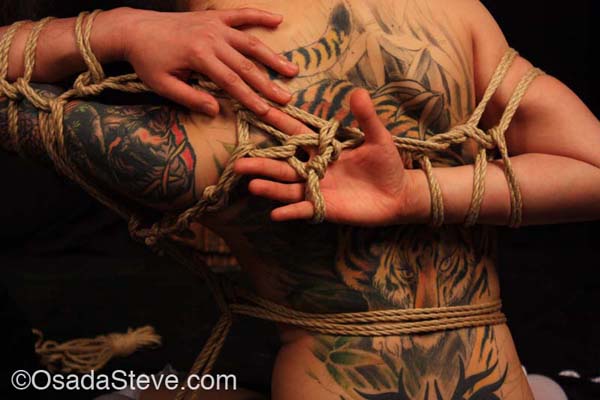
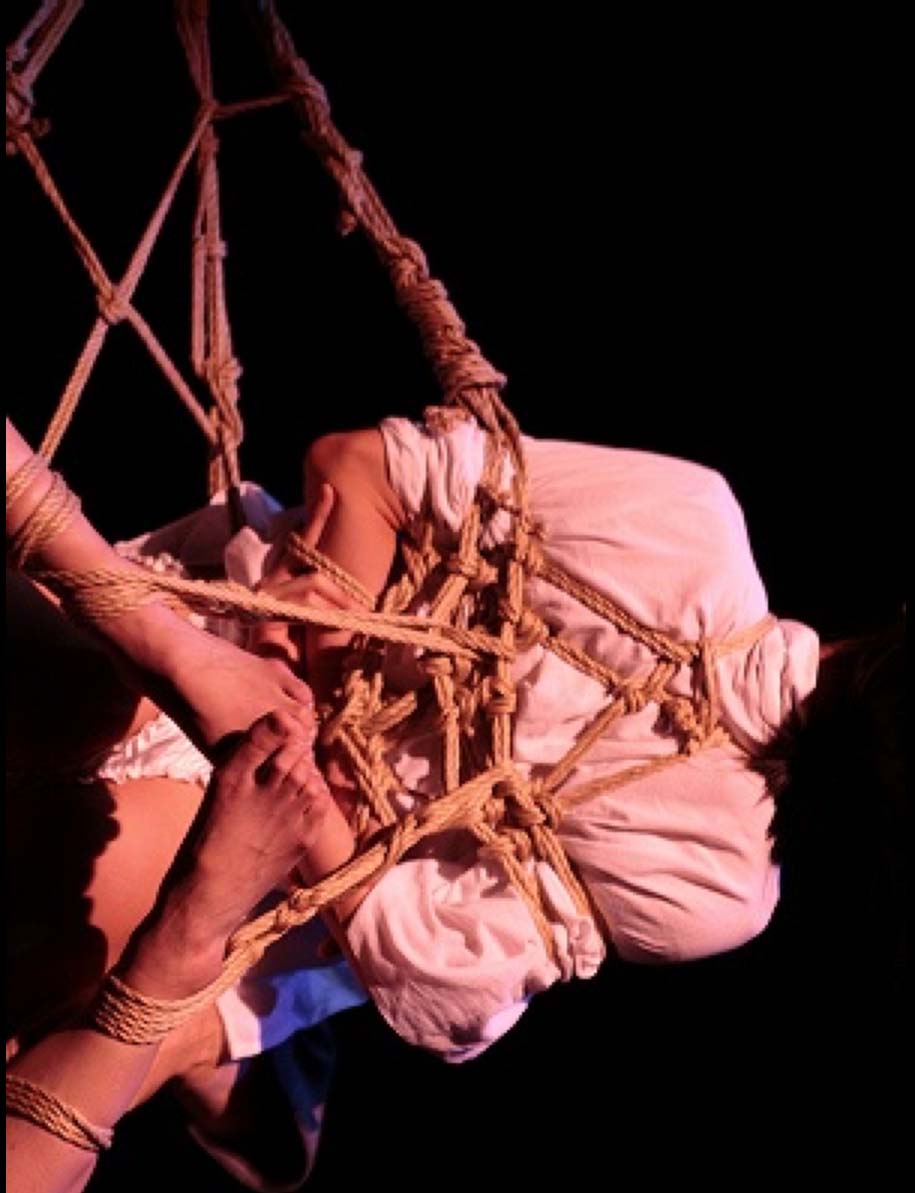
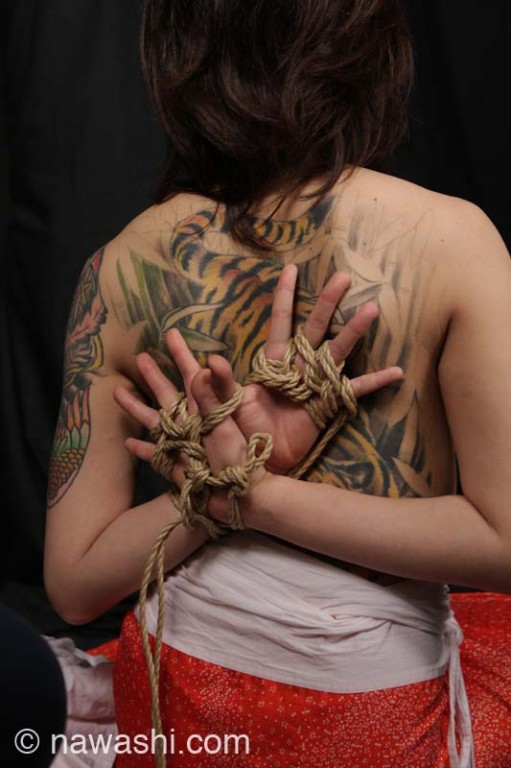
Enter the stickler faction and we learn that the term takatekote is also used to describe tying the arms in the back with the forearms at an acute angle to the upper arms, yet with the wrists still crossing each other. (See picture 1, below.) An even stricter tie would be the ushiro gassho shibari (後ろ合掌縛り, reverse prayer tie) where neither hands, nor wrists, nor forearms cross - the gold standard of gassho shibari being a position where both elbows touch each other with the forearms facing upwards perpendicular to the floor. (See picture 2, below.)
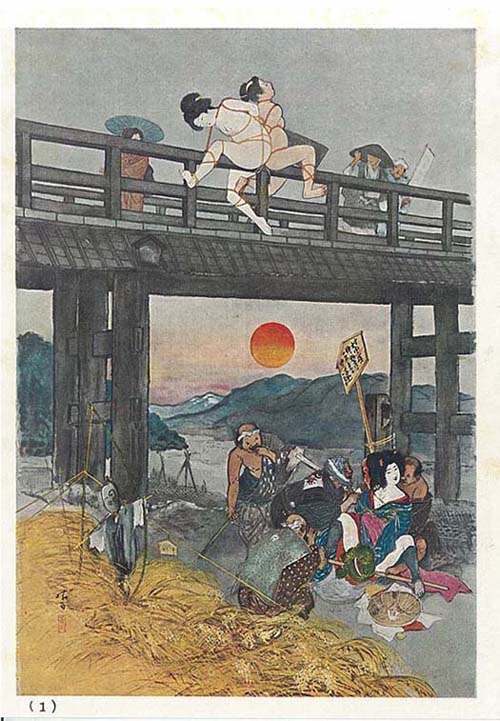
The reverse prayer tie as well as its cousin the shukke shibari (出家縛り) were actually, in the hojojutsu days, bondages applied to monks or people working or residing within temple compounds. Bondages were also developed according to class affiliation (such as warrior class, normal citizens, Buddhist priests or monks, Shinto priests, yamabushi, pilgrims, blind people, hinin, etc.), and at the same time bondages evolved that would show the type and severity of the crime. These intricacies are often lost in modern-day shibari, especially outside Japan. As a result, you will find people doing ties like the reverse prayer simply for their inherent beauty or for a giggle - missing out on the historical significance and some of the finer points of Japanese rope art, where many of the ties originally had very specific meanings.
Word List
後 - ushiro, behind
後 - go, behind
後 - ato, after
前 - mae, before
後手 - gote, hands in back
前手 - maete, hands in front
食後 - shokugo, after meals
食前 - shokuzen, before meals
午前中 - gozenchuu, morning (more precisely: the period between morning and noon)
午後 - gogo, afternoon
小手 - kote, forearm(s)
Bonus text for Sound of Music lovers and fans of the Trapp family
We all know that karaoke is short for kara orchestra (empty orchestra), or do we not? The “kara” (空) employed here is the same kara as in karate (空手) which means kind of “empty hand”.
For one-up-manship you can try to combine mae (前) with kara (空) to end up with 空前 (kuuzen). Remember? The character 前 has different readings (see main text above), one of them being “zen”. Careful now, this is not the Zen as in Zen Buddhism, which is written as 禅. Kuuzen therefore means something like “empty before”. If this is too ambiguous for you, try “unprecedented”.
Depending on context, 空 can also mean “sky” (sola). If you match it up with ki(気, as in “life force”, also pronounced chi in China, as in tai-chi), you’ll get kuuki (空気, air).
Arms positioned in the “true” takatekote position.
Arms in as-yet-incomplete gassho position. You are encouraged to assist your partner in achieving this position as part of your regular stretching exercises.
As reported earlier, the Copenhagen Shibari Dojo had been organizing an exclusive series of Yukimura Haruki (雪村春樹) workshops in August 2012. To mark the occasion, the first person ever to reach shodan level in Osada-ryu was given the name Yukinaga Max (雪長マックス).
The first kanji in Yukinaga is the “Yuki” (雪) in Yukimura. As often is the case, kanji have more than one reading, i.e. Osada could also be read as Nagata. It is that “Naga” (長) which forms the second kanji in Yukinaga (雪長).
As Yukinaga Max carries on the tradition of Japanese bondage, making it available to shibari/kinbaku enthusiasts in Europe, his name aptly represents a combination of the names of his two sensei.
There will be a Kinbaku Photo Exhibition at Shinjukuza Gallery held by three photographers: Bingo Shigonawa, Koh Ishifune, and Ou Kengou. The latter is none other than “Mr Wang” from Beijing who has documented with his camera the comings and goings of the Kinbaku Live Nights @ Studio SIX during 69 visits of the past few years — and counting. Mr Wang has also gained fame through his photos in the Aiko book.
As a special treat, Osada Steve will be giving a rare live performance on the opening day, November 20 (5pm to 8pm opening party).
The coming days will see a flurry of activity at the Copenhagen Shibari Dojo. For starters there will be five days of intensive workshops conducted by none other than Grandmaster Yukimura Haruki (August 20-24). This will be followed by a weekend of Dojo Anniversary Celebrations - featuring performances and other attractions.
Representatives from the Vienna Kinbaku Dojo will be attending too. Their website is currently in German language only, but there are plans to have an English-language version up by the end of 2016 or early 2017.
Last, but not least, I wish to thank Scott of the Melbourne Rope Dojo for doing a great job in designing the brand-new Osada-ryu website. I encourage everybody to check this site out, as it may provide answers to questions what Osada-ryu is all about.
The April WS Tour had to be canceled for health reasons.
*********************
Osada Steve will be doing two weeks of work shopping in London, conducting two 5-day workshops and offering private tuition. First week starts April 9. In the lead-up to these intensives, Esinem will offer primers in Osada-ryu with emphasis on the Osada-ryu 3-rope takatekote
(三本縄長田流高手小手) , the building block for suspensions.
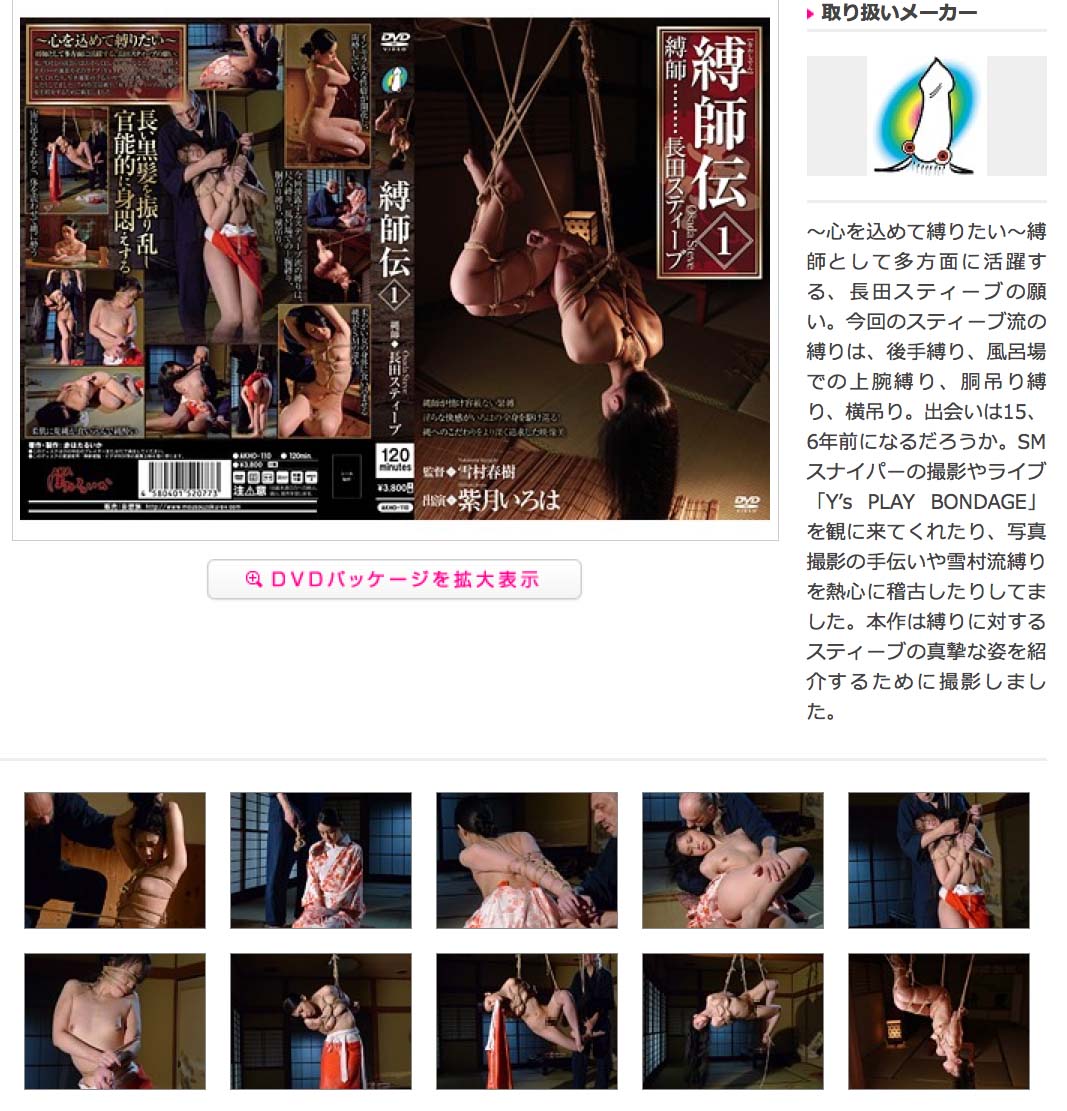
Just in time for the Holiday Season comes this deluxe collection of fine shibari/kinbaku DVDs, some containing diversions beyond the application of rope.
Special Bundles:
Get your choice of three for JPY 4,000 each, and the shipping is free.*
Get all six for JPY 3,000 each, and free shipping.*
*Offers expire by December 31, 2011.
+Each DVD can also be purchased individually for ¥4,500 plus ¥1,000 s&h (international express, tracking provided).
++Just send a mail stating the items you wish to order.
Akane-chan, at the sprightly age of 21, is a successful AV actress having starred in feature films playing in a theater near you (Nikkatsu “hitozuma” series) and in a multitude of porn flicks.
In this rare footage she submits to Osada Steve as if it were her second nature. The DVD includes Steve’s trademark newaza, followed by hashirazuri & ijime, followed by heavy whipping.
Only two other women come to mind when watching Asagi Ageha: Cleopatra and Tani Naomi (谷なおみ). With close to a thousand performances with Osada Steve under her obi, Asagi Ageha today is the undisputed self-suspension queen of Japan, dazzling the crowds from Sydney to Paris, Berlin to London.
This rare video footage shows our heroine submitting to the advances of Osada Steve at his weekly Kinbaku Live @ Studio SIX events. Watch her being driven into lustful abandon in Steve’s trademark newaza session. In scene #2 our heroine is subjected to a strict vertical suspension. The DVD concludes with various hojojutsu ties.
Juli-chan has been one of the most popular subs at Studio SIX, and after watching this DVD you will know why. She is a very sensual woman who fully appreciates Steve’s caressing style of newaza, and she is also always ready for heavy whipping and abuse. Juli-chan is a very versatile sub that you would play for keeps.
Kiku-chan is your ultimate dream woman with plenty of soft spots in all the right places. Eager to please she’ll accept any abuse you throw at her, responding with heartbreaking yelps and lots of tears. This DVD features rare ganji garame footage, eronawa, and a generous amount of impact play.
Kotone-chan ranks among the toughest and bravest subs, which makes her just the right material for a suspension expert like Osada Steve. In this DVD you will see her abused to the limit, including relentless candle wax torture, single-tail whipping, magic wand play, and a heavy dose of discipline and domination.
Starring the delightful Yuna-chan, this DVD comes (just like the Kotone DVD) with a story line and was made for Japan-wide video shop distribution. In it you see the very malleable yuna-chan at the receiving end of abuse and devilish attacks, including candle wax torture and whipping.
Spoil yourself or treat your significant other to the Aiko book and/or any or all of five Aiko DVDs for Christmas. Offer expires December 20, 2011.
*Get five Aiko DVDs for the price of two. Add ¥1,000/DVD s&h.
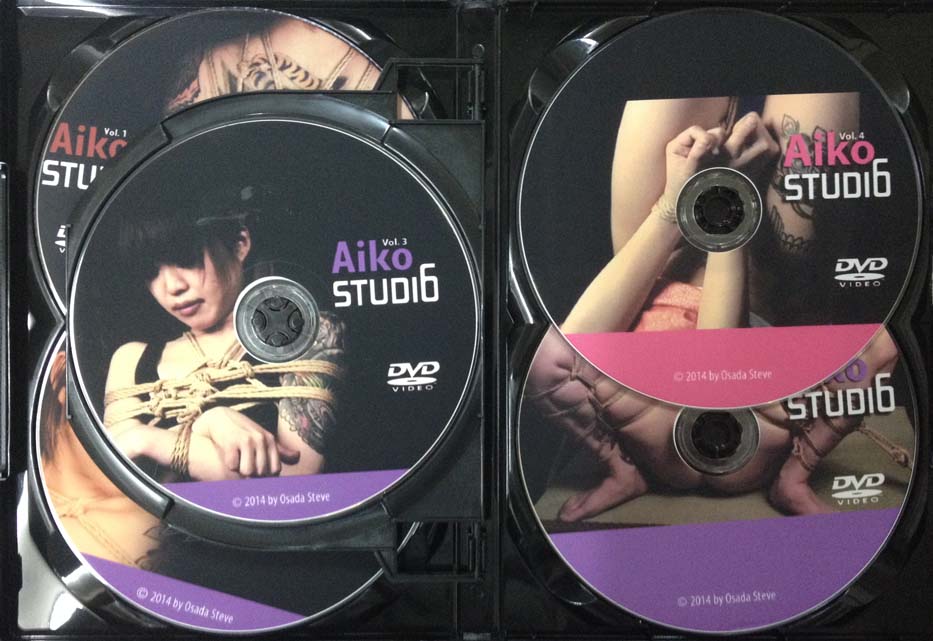
Five hours of Kinbaku Live performances @ Studio SIX featuring none other than Aiko (愛子). The filming for these took place over the same period of time the Aiko book was produced.
Order the Aiko book with the 5-DVD set as a bundle for ONLY ¥19,600, and s&h for the book will be FREE. Offer expires December 20, 2011.
+Each DVD can also be purchased individually for ¥4,500 plus ¥1,000 s&h (international express, tracking provided).
++Just send a mail stating the items you wish to order.